
How to Search Cass County Court Records
Cass County court records live in a small set of official channels rather than one giant database. The main statewide tool is MiCOURT Case Search, which can surface civil, criminal, traffic, family, and probate cases. The county court website also links separate case lookup and live docket pages for the district, circuit, and probate courts. Those dockets update every 30 minutes and can change without notice. So a records search here often means picking the right court first, then the right tool.
A little prep speeds things up. Have the full party name or the case number ready. Know the rough case type, since that points you to the correct court. Traffic tickets follow their own path through a state ticket portal. Deeds sit in a separate recorded-document system. Some older files never went online at all.
The county court system gathers the district, circuit, and probate entry points on a single Cass County courts home page.
That hub is the quickest way to reach the correct Cass County court records lookup for your case type. From there, follow a simple order.
- Start at the county court home page and choose district, circuit, or probate.
- Open MiCOURT Case Search when you need a statewide or multi-court entry point.
- Use a local court lookup page when you already know the court type.
- For traffic tickets, use the state ticket search portal or the district pay-tix page.
- For deeds and land records, use the recorded document search, not MiCOURT.
- For older or paper-only files, call or visit the matching file room or clerk office.
- For records not public online, use a request only where the law allows.
Traffic cases route through the Michigan ePAY ticket and case search portal, which uses its own set of fields. The table below lists what the portal asks for.
| Field | Type | Required | Notes |
|---|---|---|---|
| County | Dropdown | Yes | Select Cass. |
| Court | Dropdown | Yes | Court selector. |
| Last Name | Text | For name search | Pairs with a ticket number or date of birth. |
| Ticket / Case # | Text | No | Citation or case number. |
| Date of Birth | Date | No | Month, day, and year. |
| Driver Lic # | Text | No | Needs a state selector. |
| License Plate # | Text | No | Needs a state selector. |
The Cass County Judicial System
Michigan splits trial work across three local courts, and Cass County follows that pattern. The 43rd Circuit Court is the court of general jurisdiction. It hears felonies, civil suits of $25,000 or more, family and domestic matters, juvenile cases, and appeals from the lower courts. The 4th District Court is the high-volume trial court. It manages traffic, misdemeanors, small claims, landlord-tenant disputes, and the front end of felony cases before bindover to circuit court.
Probate Court stands apart with its own docket and staff. Circuit Chief Judge Carol Montavon Bealor also presides over probate. Judge Mark A. Herman handles many criminal and family matters, and District Judge Stacey A. Rentfrow runs the district bench. A case can climb the chain on appeal, moving from the trial court up to the state review courts.
Case flow: District Court › Circuit Court › Michigan Court of Appeals › Michigan Supreme Court
| Court | Jurisdiction | Case Types |
|---|---|---|
| 4th District Court | Claims up to $25,000; jail terms up to one year | Traffic, misdemeanors, small claims, landlord-tenant, preliminary exams |
| 43rd Circuit Court | General jurisdiction; claims of $25,000 or more | Felonies, family law, juvenile, personal protection, appeals |
| Probate Court | Statutory jurisdiction over estates and protective matters | Wills, trusts, guardianships, conservatorships, mental health, adoptions |
Circuit, District, and Probate at a Glance
The three courts overlap less than people expect. Each one owns a clear lane. Matching your issue to the right lane saves a wasted trip to the wrong file room. The side-by-side view below lines up what sets each court apart.
| Feature | 4th District Court | 43rd Circuit Court | Probate Court |
|---|---|---|---|
| Core cases | Traffic and misdemeanors | Felonies and family law | Estates and guardianships |
| Civil money range | Up to $25,000 | $25,000 or more | Set by estate value |
| Criminal role | Arraignment and bindover | Felony trial and sentence | None |
| File room phone | 269-445-4424 | 269-445-4416 | 269-445-4454 |
Note: Every adult criminal case begins in the district court, even a felony, so a serious charge may show early events there before it reaches circuit court.
Types of Court Records Available in Cass County
The public record universe here tracks the Michigan court structure. The main types a reader will search are civil, criminal, traffic, domestic relations, probate, juvenile, small claims, and appeals. The county site sorts them by court, which is a strong clue that each record type has a different home. Match the type to the court and the search gets simple.
Civil and small claims split between the two trial courts by dollar amount. Criminal files begin in district court and move to circuit court on felonies. Family records run through the circuit court and the Friend of the Court. The Cass County government site ties these offices together for the public.
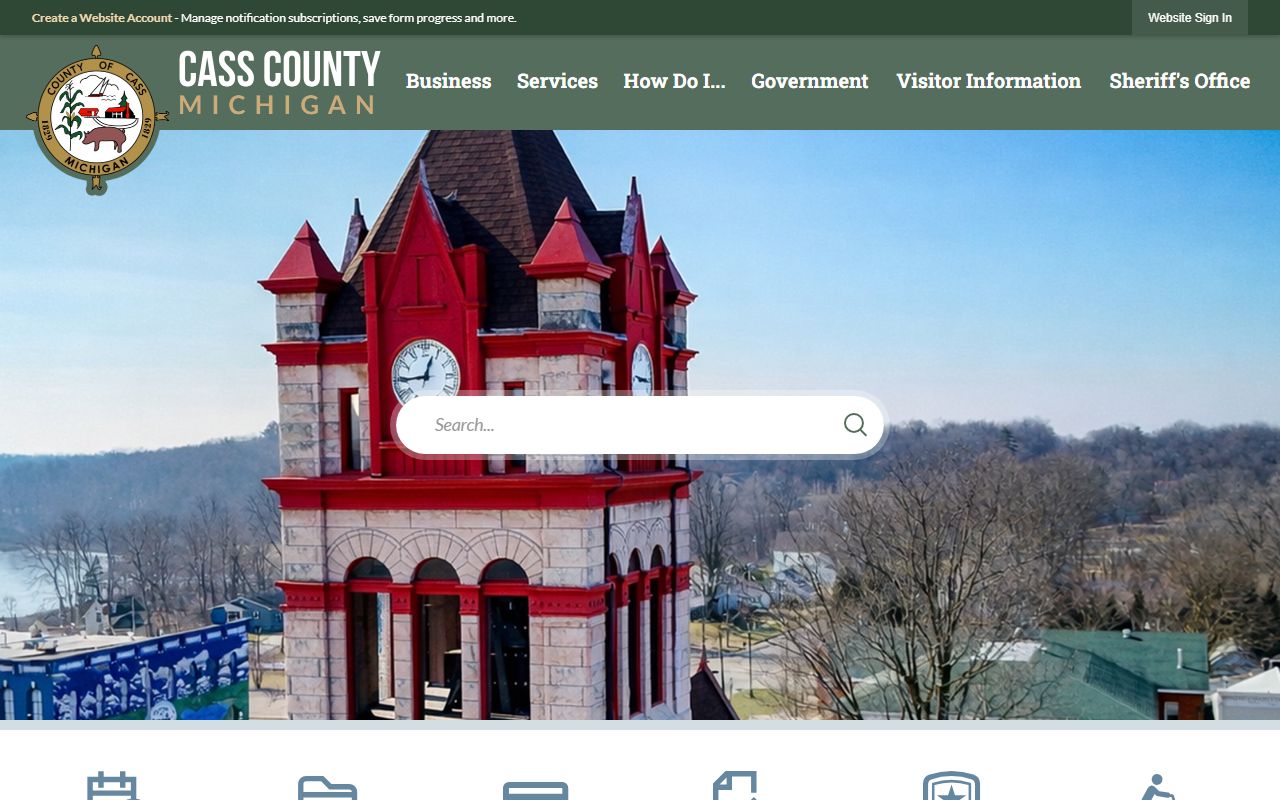
That county portal is where record seekers reach the clerk, sheriff, and court links in one place. The categories below show what each record group covers.
- Criminal records - charges, pleas, dispositions, and sentencing across district and circuit court.
- Civil records - complaints, motions, orders, and judgments in money and property disputes.
- Family and divorce records - divorce, custody, support, and paternity matters in circuit court.
- Probate records - estates, wills, trusts, guardianships, and mental health filings.
- Traffic records - citations, court dates, and dispositions kept by the district court.
What Cass County Court Records Show
Cass County court records use standard Michigan data fields, and the live docket pages show the most useful ones. A district docket row lists the party name, hearing time, hearing type, case number, and courtroom. That means the county docket view is event-oriented, not just a flat case summary. Readers can expect the hearing type, the party, and the prosecutor designation to appear on live docket pages.
Not every field is public. The state case search warns that some information is precluded from disclosure by state and federal law. So a public record is not always a complete record. The field guide below covers what a typical case entry shows.
| Field | What It Shows |
|---|---|
| Case Number | The unique court file identifier for the matter. |
| Filing Date | The date the action started. |
| Parties | Plaintiff, defendant, petitioner, or respondent names. |
| Charges / Cause | The charge, statute, or reason the case was filed. |
| Disposition | How the case ended, such as dismissed or closed. |
| Sentence / Judgment | The final penalty or the money award. |
Public Access Laws for Cass County Court Records
Michigan access law blends the Freedom of Information Act, court rules, and record-specific statutes. Cass County makes one point plainly. The judiciary, including the clerk when acting as clerk to the circuit court, is not a public body under FOIA. That is why court files are not handled like ordinary county FOIA records. Court files go through MiCOURT or the file room, while county administrative records go through the FOIA path.
A handful of statutes shape what the public can see. Each one below links to the official text with a short plain-English note.
Key Statutes:
MCL 15.231 - the state open-records act that governs county public records in general.
MCL 15.232 - defines a public body and excludes the judiciary, so court records fall outside county FOIA.
MCR 8.119 - the court rule that sets what a court record is, plus public access and sealing.
MCL 780.621 - the main statute for setting aside, or expunging, a conviction.
MCL 712A.28 - juvenile records are kept by the court and opened only by court order.
Records That Are Restricted or Confidential
Some categories stay closed even when a docket exists. Juvenile records lead the list. Under state law they are held by the court and open only by court order, and a separate social file is shared only with people who have a legitimate interest. Adoption files are also sensitive, and mental health proceedings can be partly closed because of the personal data involved.
Sealed and expunged records work differently from ordinary public files. When a conviction is set aside, the systems remove or hide it. Personal identifiers get redacted as a matter of routine. That list includes Social Security numbers, financial account numbers, the names of minors, and health details protected by court rule.
Note: A sealed or expunged case usually cannot be reopened to the public without a new court order, so a records request alone will not undo the restriction.
Specialty Courts in Cass County
Cass County runs a real problem-solving court footprint, and the court pages are clear about it. These programs pair a criminal case with treatment and close supervision. The county frames them as evidence-based courts that improve outcomes, restore families, and make the community safer. State grants have recently backed the county's treatment-court work.
The programs split between the two trial courts. District Judge Stacey A. Rentfrow presides over the treatment and sobriety tracks. Circuit Judge Mark A. Herman leads the mental health and sanctions programs.
- Adult Treatment Court, on the district court side.
- Sobriety Court, also on the district court side.
- Mental Health Court, on the circuit court side.
- Swift and Sure Sanctions Probation Program, on the circuit court side.
Cass County Courthouses
Cass County uses two courthouse-era buildings, both in Cassopolis, and the difference matters. The active courts sit in the Cass County Law and Courts Building on M-62, which opened in 2003. The historic 1899 courthouse on North Broadway now anchors a county renovation project. Sending a visitor to the wrong door is a common mistake, so the address you use should match the court you need.
Public service windows in the Law and Courts Building run from 8:00 AM to noon and 1:00 PM to 4:30 PM. Entry after 4:45 PM is limited because the service windows close at 4:30 PM. The county building facilities page lists standard county hours of Monday through Friday, 8:00 AM to 5:00 PM.
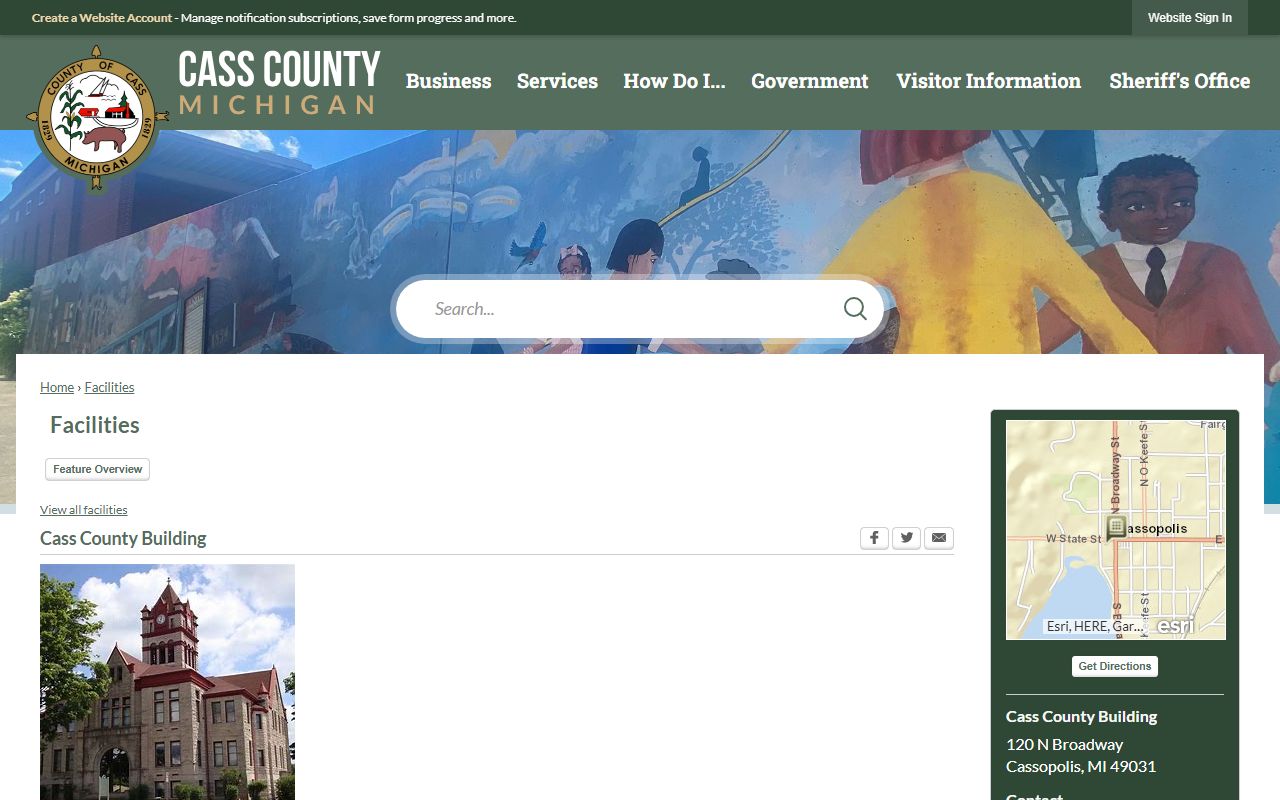
That facilities listing confirms the operating hours a records visitor should plan around. The historic building tells the other half of the story.
County commissioners voted in October 2022 to fund the renovation of the old courthouse so it can serve as an administrative hub again. The historic courthouse project page lays out the building history and the construction timeline.
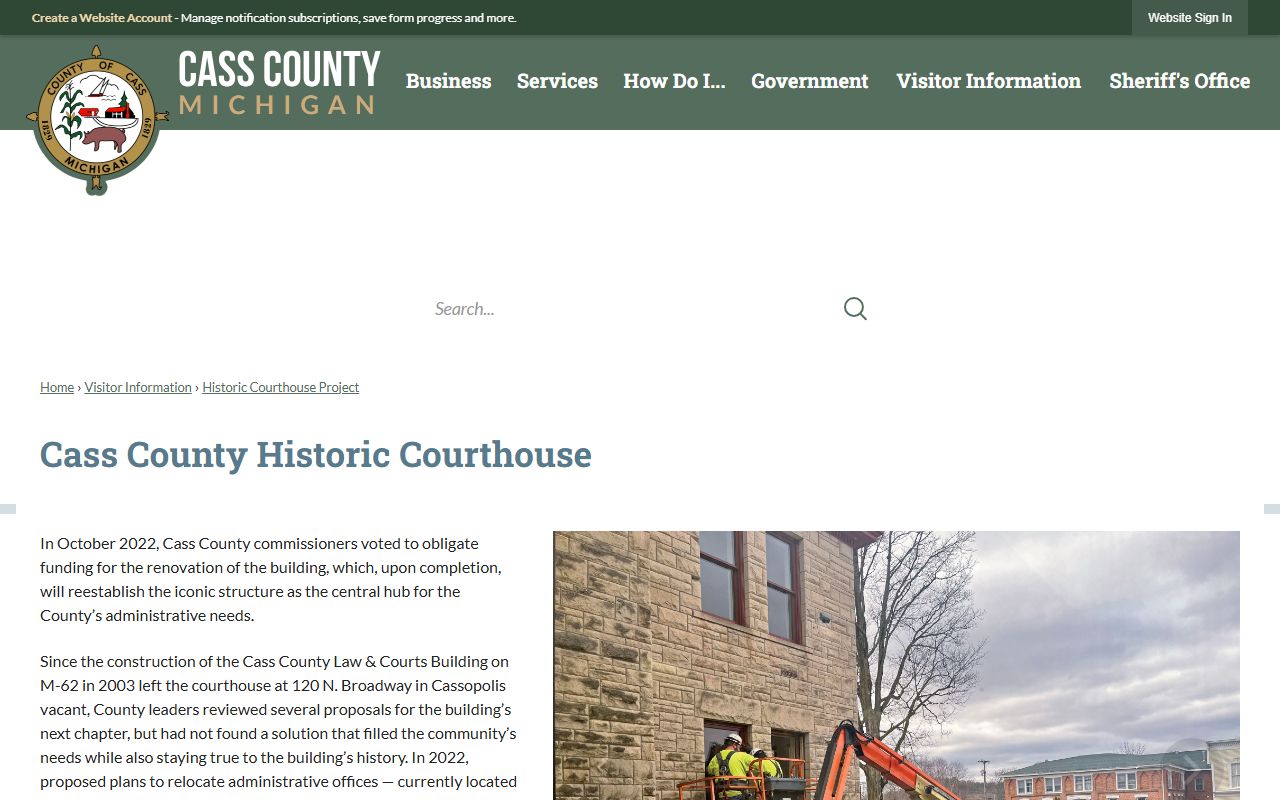
That project page shows how the county is preserving its judicial past while modern court records work stays on M-62. The cards below give the key addresses.
Clerk/Register of Deeds Office
120 N Broadway, Suite 200
Cassopolis, MI 49031
269-445-4464
Cass County Sheriff and Jail
The Cass County Sheriff's Office runs the jail and the custody-access channels. Sheriff Clint Roach leads the office at 321 M-62 in Cassopolis, and the main phone line is 269-445-8644. The county does not post a full public jail roster on the pages reviewed. Instead, it points people to custody status through the MI-VINE notification service. Jail captain Jon Shoup oversees corrections operations.
The county elected officials page names the current sheriff, clerk/register, and prosecutor.
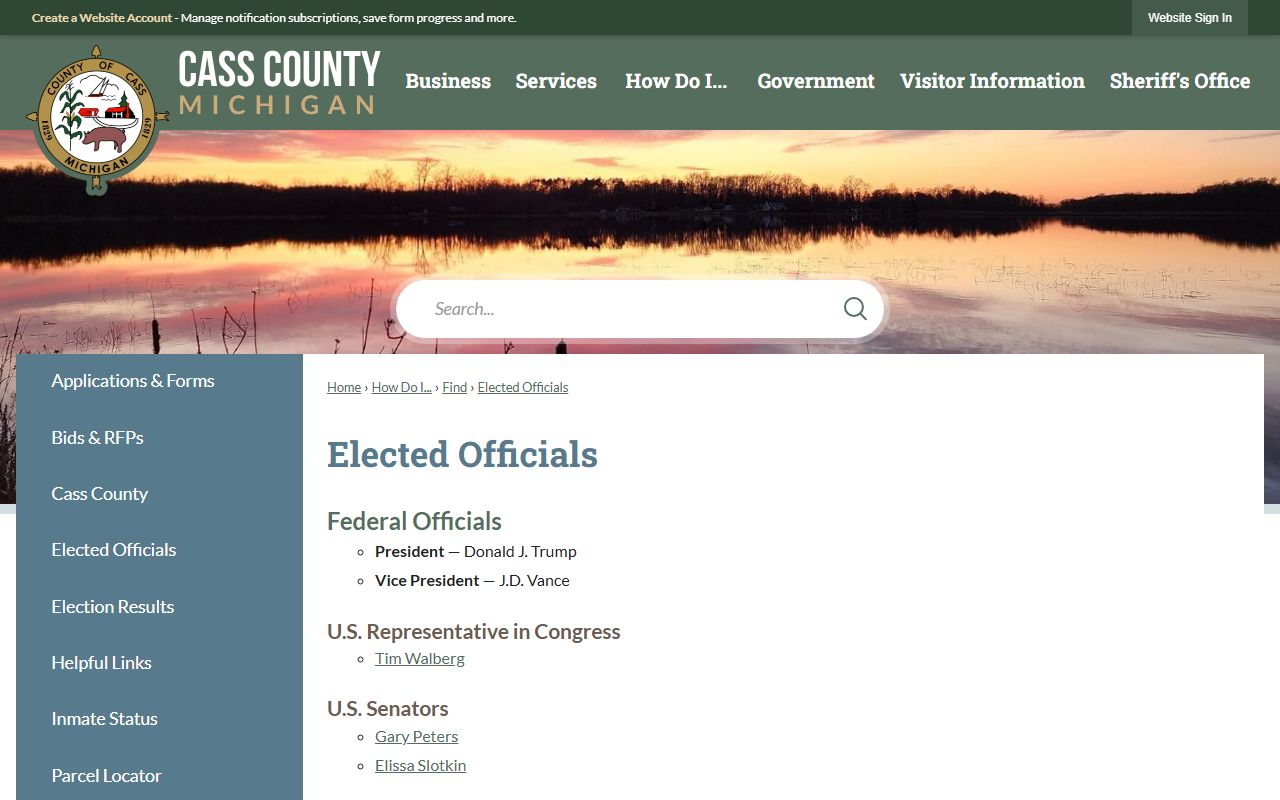
That roster confirms who leads each office tied to the record system. For custody detail, the Cass County inmate records page covers the jail search paths, and the warrant records page covers active-warrant fallbacks.
Marriage, Divorce, and Probate Records
Marriage licenses are clerk records, not court files. The County Clerk/Register of Deeds issues them, and applicants can apply in person or online. A Michigan resident applies in the county where one applicant lives. The office also holds certified marriage and death copies. For the full application path, see the Cass County marriage and divorce records page.
Divorce works differently. Every divorce is a court file that starts with a complaint in circuit court, and the Friend of the Court shapes support and parenting terms. Estates, wills, and guardianships route to the probate records court instead. A few common terms help when reading these files.
- Testator
- The person who makes a will.
- Executor
- The person named to carry out a will.
- Intestate
- Dying without a valid will.
- Conservator
- A person appointed to handle another's finances.
- Guardian
- A person appointed to handle another's care.
Cass County Court Records Fees
Fees vary by the office and the record. The clerk/register charges for copies of vital and land records. The probate court has its own schedule, plus an e-filing charge added to many filings. Certified copies cost more than plain copies, since certification carries a seal. The table below gathers the common amounts a records seeker will meet.
| Item | Amount |
|---|---|
| Plain copy per page | $1 |
| Probate certified copy, first page | $11 (plus $1 each added page) |
| Certified marriage or death copy | $15 ($5 each added copy) |
| Deed print at public workstation | $1 per page |
| Marriage license, Michigan resident | $20 |
| Marriage license, out-of-state resident | $30 |
| Probate decedent estate filing | $175 plus inventory fee |
| Court e-filing system fee | $25 |
Public deed searches at the clerk's workstations are free, and only the prints carry a charge. Probate inventory fees scale with the gross estate value, and the county posts a calculator on its fee page.
How to Interpret Cass County Court Records
Reading a Cass County court record takes a little translation. A docket lists events in order, so the newest line is not always the outcome. A charge is only an accusation, while a conviction is a proven result, and the two should never be read as the same thing. A disposition tells you how the case ended, such as a dismissal, a plea, or a verdict.
Case-type letters offer a quick clue to the court and the subject. Criminal files often carry a CR label, civil files a CV label, family matters an FM label, juvenile cases a JV label, and probate matters a PR label. Confirm the exact prefix on the live record before you rely on it, because formats can shift.
Note: A closed or disposed status means the court finished its work on the case, but appeals or later motions can still add new entries to the file.
History of Cass County Courts
Cass County was organized in 1829 and named for Lewis Cass, the Territorial Governor of Michigan. That gives the court system a long institutional history that predates the current website by nearly two centuries. The county seat has always been Cassopolis. The Michigan county guide for Cass records the founding date and the county's early settlement notes.
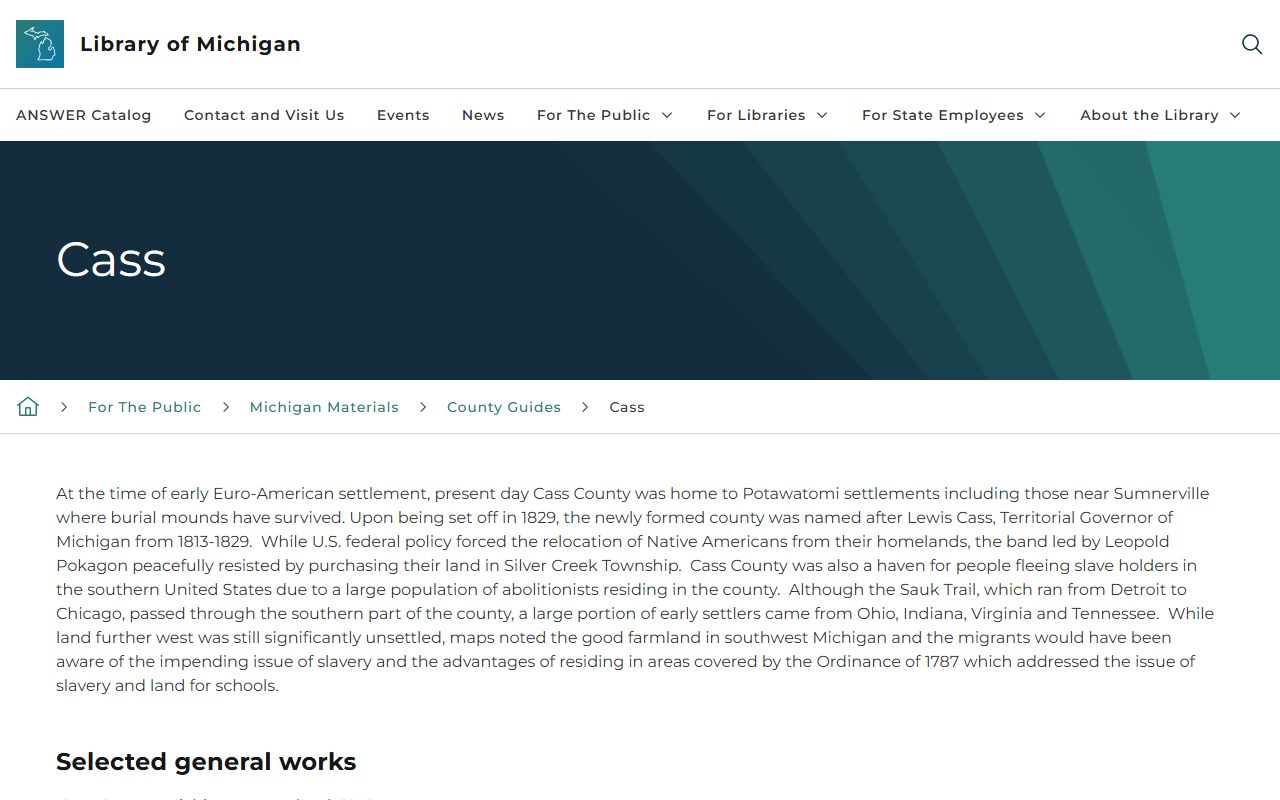
That state guide anchors the county's origin story before the modern courthouse era. The building history picks up in 1899.
The historic courthouse on North Broadway opened in 1899 and served for over a century. When the Law and Courts Building opened on M-62 in 2003, the older building went quiet, and county offices moved to the new campus. A county archive article covers the 1899 building and its place in local memory. See the historic courthouse archive article for the building story.
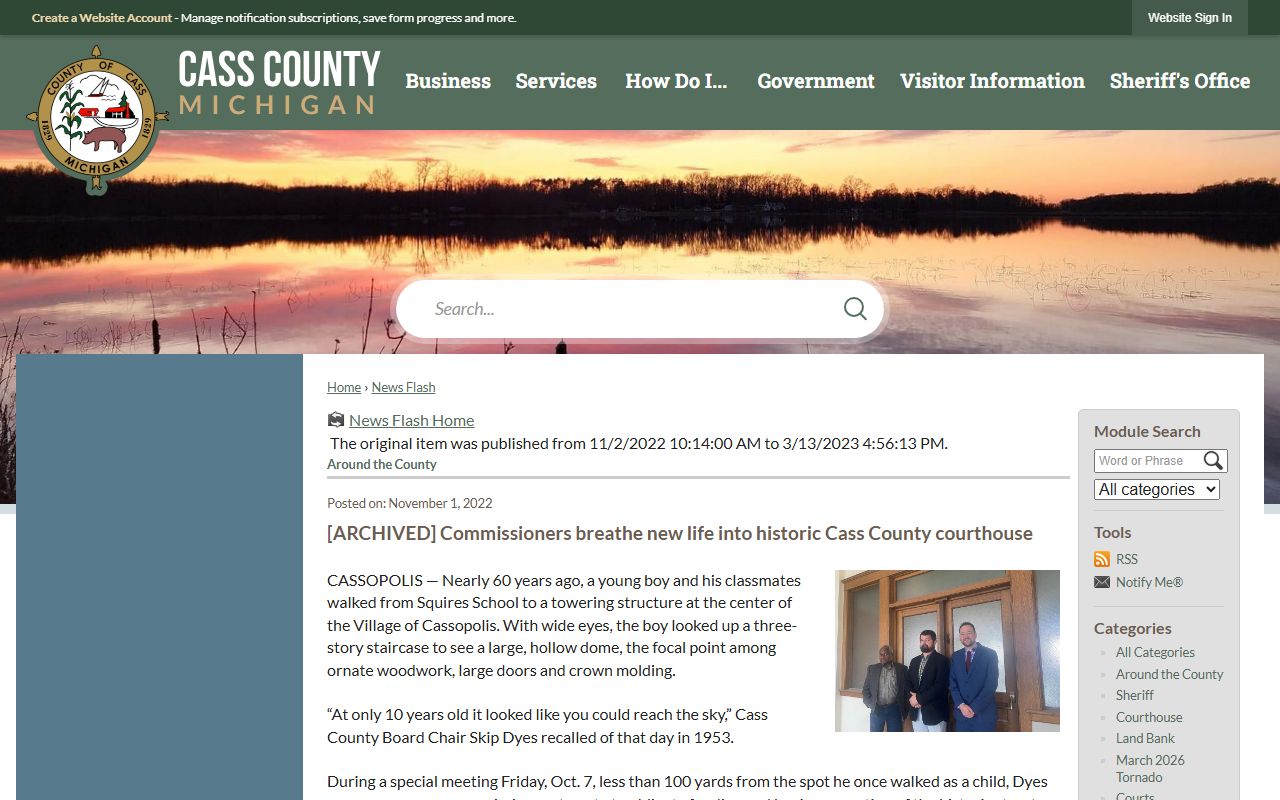
That archive piece explains why the county still names two courthouse addresses today. The 2022 renovation vote set the older building on a path back into county service.
Frequently Asked Questions
How do I search Cass County court records online?
Start at the county court home page and pick the district, circuit, or probate court. For a statewide entry point, use MiCOURT Case Search, which covers civil, criminal, traffic, family, and probate cases. Traffic tickets have their own state ticket portal. If a case is old or paper-only, call the matching file room. Land records use a separate recorded-document search rather than the court case search.
Are Cass County court records free to view?
Yes, the online case search and the live dockets are free to use. You only pay when you order copies. Plain copies run about a dollar per page, and certified copies cost more because they carry a court seal. Not every record is visible online, since state and federal law keep some information out of public view.
Which court handles my case in Cass County?
It depends on the matter. The district court takes traffic, misdemeanors, small claims, and the start of felony cases. The circuit court takes felonies, larger civil suits, family law, and appeals. The probate court takes estates, wills, guardianships, and mental health matters. Matching the case type to the court is the fastest way to find the file.
How do I get a certified copy of a court record?
Contact the file room or clerk office that holds the case. Probate certified copies start at $11 for the first page. Certified marriage and death copies from the clerk are $15. Bring the case number, the party names, and payment. Certified copies matter for legal use, since an uncertified printout is not always accepted by other agencies.
Does Cass County post a public jail roster or warrant list?
No. The county does not publish a standing jail roster or an active-warrant list on the pages reviewed. For custody status, it points people to the MI-VINE notification service. For warrant questions, the practical route is the sheriff phone line, a records request, or the court that issued the warrant. State tools track supervision, not local pretrial custody.
How current are the online dockets?
The county's live dockets update every 30 minutes. Even so, hearing schedules can change without notice. Treat the docket as a live view, not a fixed record. If a hearing date is critical, confirm it with the court before you travel. Always verify a key detail with the originating office before you rely on it.