
How to Search Cass County Traffic Court Records
The main lookup tool is the Michigan ePAY ticket and case search portal. It is a free statewide system, not a county-owned database, and Cass County uses it for traffic citations filed in the 4th District Court. The portal shows active, paid, dismissed, and closed tickets once the court records them. Some cases may not appear right away, and the system can go down for routine maintenance.
Gather a few details before you start. You will move faster with the ticket or case number, the driver's last name, a date of birth, a driver license number, or a license plate. Each of these can serve as a search key. Pick the one you have on hand.
The official ticket portal is the Michigan ePAY ticket and case search, which opens with county and court selectors at the top.
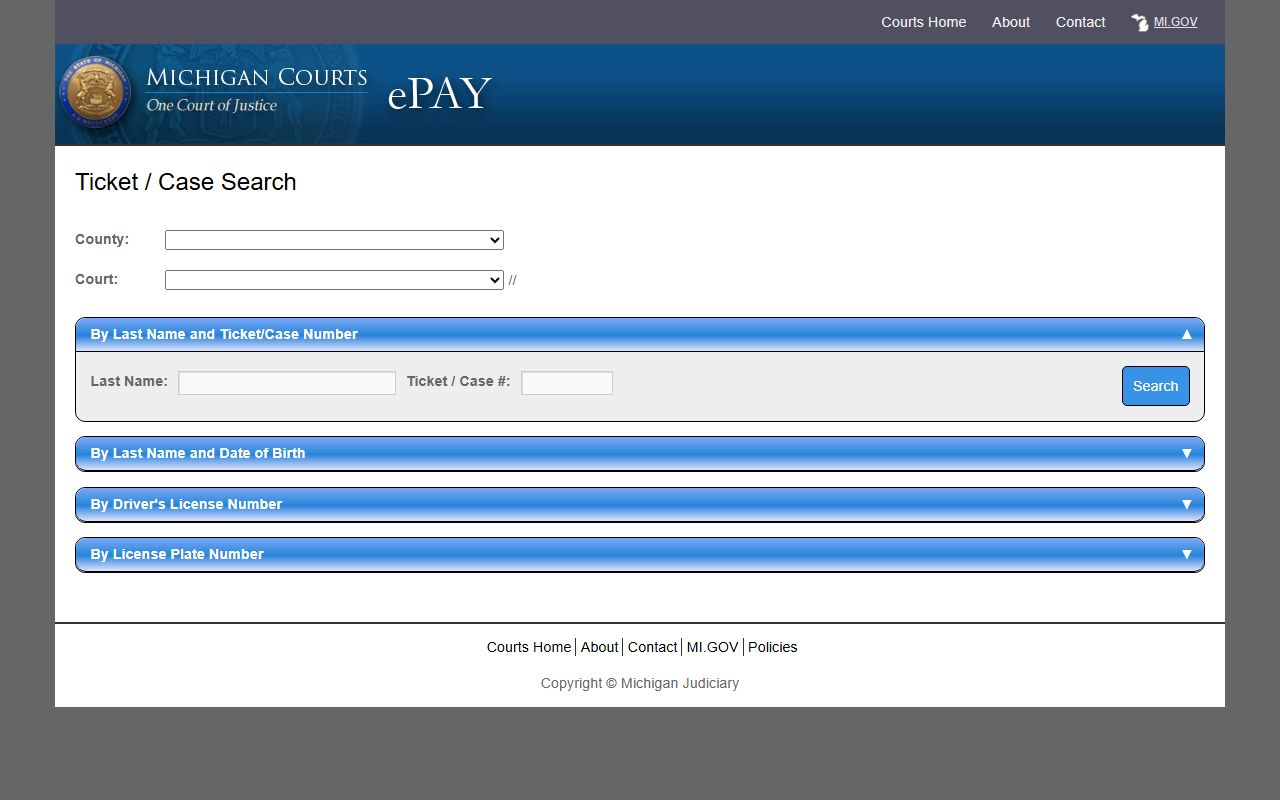
After you pick Cass County and the district court, the same screen lets you search by name, ticket number, date of birth, license, or plate. The steps below walk through a basic lookup.
- Open the Michigan ePAY ticket and case search portal.
- Choose Cass County and the 4th District Court from the two dropdowns.
- Search by last name with the ticket or case number, or by last name and date of birth.
- To use a different key, enter the driver license number or license plate with the state selector.
- Review the citation, charge, court date, and disposition, then pay online or call the court to contest.
Which Courts Handle Traffic Cases in Cass County
Cass County has no municipal or justice court. The 4th District Court is the trial court for traffic, and the county traffic page is clear about that. A district court where the violation happened handles civil infractions and misdemeanor traffic offenses. The 43rd Circuit Court steps in only for felony-level driving crimes and for appeals from the district court.
Both courts sit at the same Law and Courts Building on M-62 in Cassopolis. That keeps traffic filing, hearings, and appeals on one campus. The table below shows how the two courts split the work.
| Court | Traffic Cases Handled | Address |
|---|---|---|
| 4th District Court | Civil infractions, misdemeanor traffic, first and second OWI, arraignments | 60296 M-62, Cassopolis, MI 49031 |
| 43rd Circuit Court | Felony traffic such as a third OWI, and appeals from district court | 60296 M-62, Cassopolis, MI 49031 |
For questions about paying or contesting a ticket issued in the county, the traffic page tells drivers to call the 4th District Court at 269-445-4430.
Types of Traffic Cases on Record
Michigan splits traffic matters into civil infractions and crimes. The county traffic page puts it plainly. A civil infraction is an offense that is not serious enough to be a crime, but serious enough to deserve a sanction other than jail. Speeding and parking are the examples the county uses. Crimes such as drunk driving are a separate track.
Most tickets a driver sees fall into a handful of groups. Each type has its own place on the record and its own effect on a driving history.
- Moving violations - speeding, failure to stop, and improper lane use that add points on conviction.
- Non-moving and equipment - defects like a broken light or an expired registration.
- Parking - standing and parking tickets, usually with no points.
- Commercial and CDL - violations by commercial drivers, which carry stricter rules.
- Misdemeanor traffic crimes - drunk driving, driving on a suspended license, and similar charges that route to criminal court.
What Cass County Traffic Court Records Show
A traffic court file is event based, much like the county's live dockets. It ties a citation to a charge, a court date, and a final result. The state uses standard court data fields, so most records read the same way once you know the columns. The table lists the fields you will see most often.
| Field | What It Shows |
|---|---|
| Citation Number | The ticket or case identifier assigned when the citation is filed. |
| Charge / Statute | The violation charged and the code section behind it. |
| Court Date | The scheduled hearing or appearance date and time. |
| Disposition | The outcome, such as responsible, dismissed, or reduced. |
| Fine Amount | Fines, costs, and any late penalty owed to the court. |
| Points Assessed | Points tied to the conviction and reported to the state. |
Some data stays hidden. Michigan case search warns that state and federal law preclude the release of certain information, so a public record is not always a complete record.
Searching by Citation Number vs by Name
A citation number is the cleanest way to find one ticket. It points to a single case and skips the guesswork. A name search casts a wider net and can return several people, so a date of birth or a license number helps narrow it. Wrong ticket formats and misspelled names are the most common reasons a search comes back empty.
The ePAY portal accepts several search keys. The field table below shows what the portal asks for and which entries are required.
| Search Field | Type | Required | Notes / Format |
|---|---|---|---|
| County | Dropdown | Yes | Select Cass County. |
| Court | Dropdown | Yes | Select the 4th District Court. |
| Last Name | Text | Yes for name searches | Used with a ticket number or a date of birth. |
| Ticket / Case # | Text | No | The ticket or case number from the citation. |
| Date of Birth | Date selectors | No | Month, day, and year dropdowns. |
| Driver Lic # | Text | No | Requires the state selector. |
| License Plate # | Text | No | Requires the state selector. |
The district court also runs a pay-tix search with the same flow, listed under a remote court number.
You can see that layout on the district court PayTix ticket search page, which mirrors the main portal.
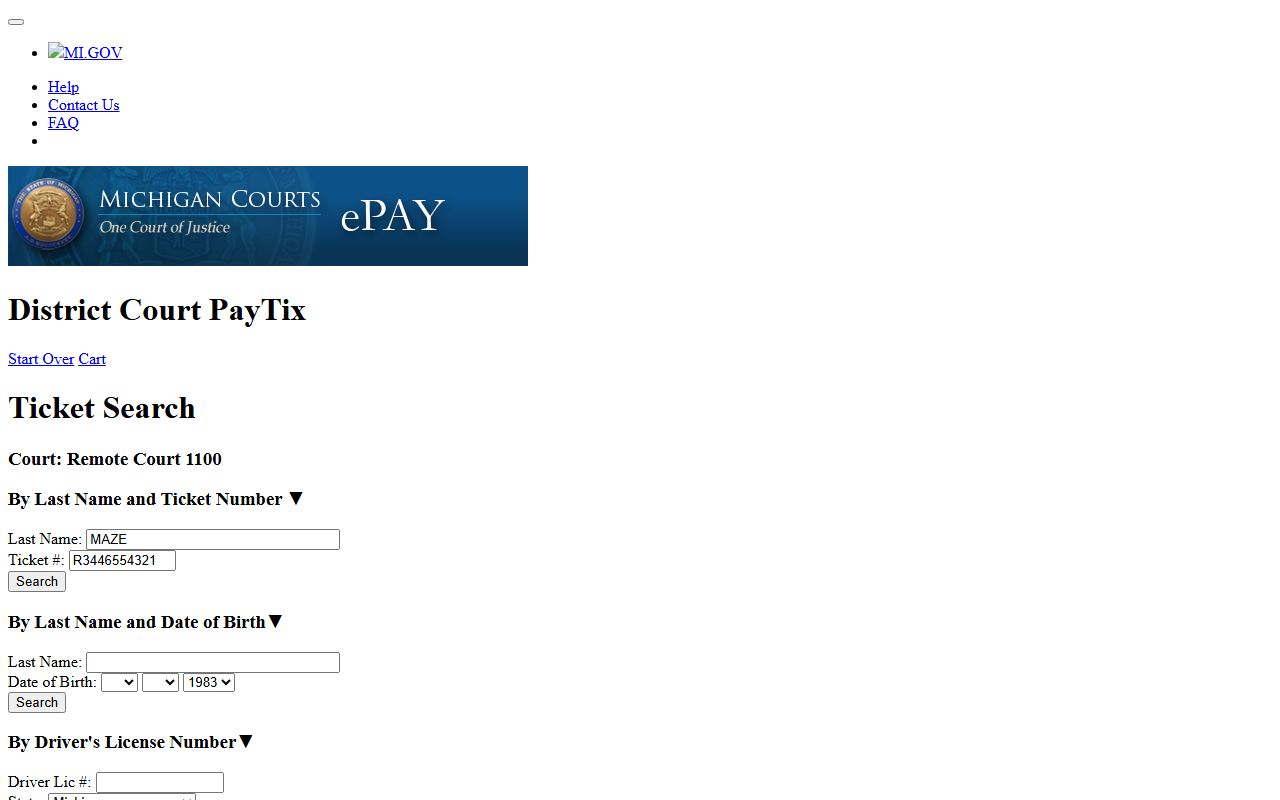
Either tool works for a Cass County citation, so pick the one that loads and use the search key you have.
Paying or Contesting a Cass County Traffic Ticket
A ticket gives you a choice. You can admit responsibility and pay, admit with an explanation, or deny responsibility and ask for a hearing. Payment can run online through ePAY, by phone, or in person at the court. Deadlines matter, and a missed deadline can add a late penalty or a hold on your license.
Contesting a civil infraction means a hearing before a magistrate or judge. An informal hearing needs no lawyer and no formal rules of evidence. A formal hearing allows attorneys and follows court procedure. To set either one, or to ask about payment, call the 4th District Court at 269-445-4430. The steps below outline the path from ticket to disposition.
- Locate the citation through the ePAY portal or read the number off the ticket.
- Decide whether to admit responsibility, admit with an explanation, or deny responsibility.
- To pay, submit payment online through ePAY or arrange it with the 4th District Court.
- To contest, call the 4th District Court at 269-445-4430 and ask for an informal or formal hearing.
- Appear on the scheduled date, or request a new date before the hearing if you cannot attend.
- Confirm the disposition, and expect any conviction to be reported to the Secretary of State.
Note: Paying a ticket counts as admitting responsibility, so a conviction can be added to your driving record and reported to the state.
Public Access Laws for Traffic Court Records
Traffic files are court records, so they follow Michigan court rules rather than the ordinary county open-records path. The county says it plainly. The judiciary, including the clerk when acting as clerk of court, is not a public body under the state Freedom of Information Act. That is why a traffic case comes from the court search, not a general county request.
Two rules shape what the public can see. The court records rule governs access and sealing, while the FOIA definition explains why the judiciary sits outside the usual request process.
Key Statutes:
Michigan Court Rule 8.119 - defines court records and governs public access, sealing, and electronic access.
MCL 15.232 - defines a public body and excludes the judiciary, so court files are not ordinary FOIA records.
Court Traffic Records vs State Driver Records
This is the split that trips up most drivers. The court traffic record is the case file. It holds the citation, the charge, the court date, the plea or disposition, and the fine. The state driver record is a separate file kept by the Secretary of State. It shows licensing history, convictions reported to the state, points, and license status. A dismissal in court is not the same as a clean driving record.
The comparison below lines up the two files side by side, from where they come from to how you fix a mistake in each.
| Comparison Point | Court Traffic Record | State Driver Record |
|---|---|---|
| Record source | 4th District Court file | Michigan Secretary of State |
| What it contains | Citation, charge, court date, disposition, fine | Licensing history, reported convictions, points, status |
| Where to access | Michigan ePAY ticket search or the court file room | Purchased from the Secretary of State |
| How to correct errors | Contact the 4th District Court that holds the case | Contact the Secretary of State that keeps the abstract |
The Secretary of State explains the two files on its driver and vehicle records FAQ, which covers who can buy a record and why.
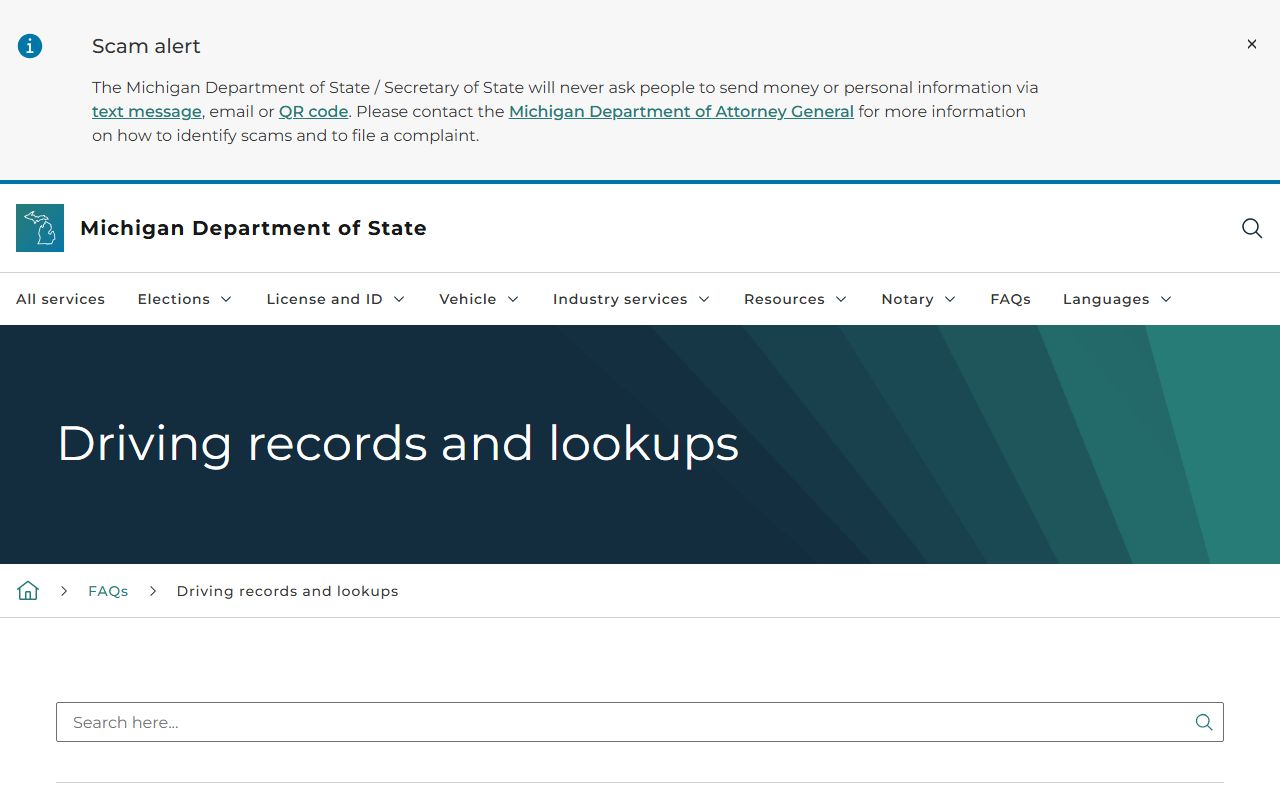
The same office keeps vehicle files as well as driver files, so a plate or title question follows a different track.
You can review that track on the state vehicle history record page, which explains what a vehicle record shows.
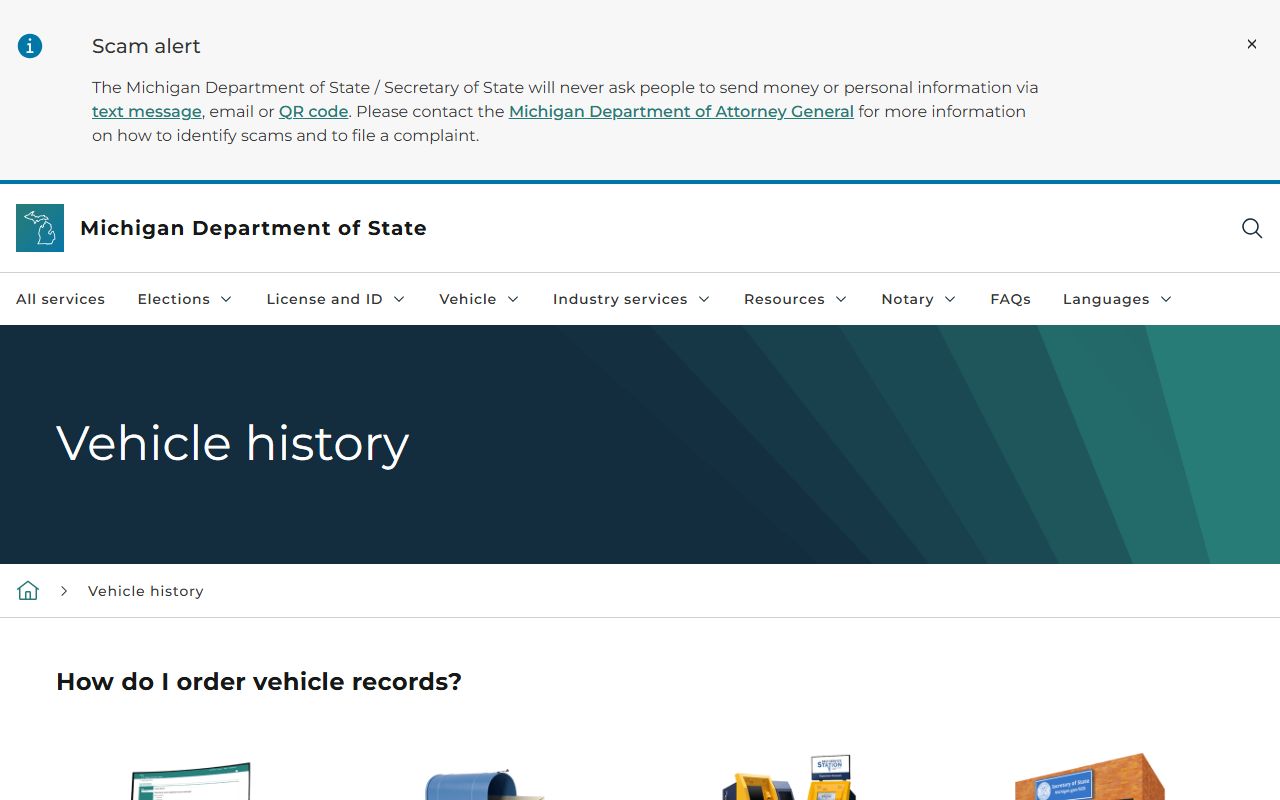
A vehicle history is not a traffic case record, so use it only for title and registration questions, not for a citation.
CDL and Commercial Driver Records
Commercial drivers face a stricter version of the same system. A conviction on a commercial driver, even in a personal vehicle, is reported to the Secretary of State and can hit a commercial license harder than a regular one. That makes the driver record, not just the court file, the record a CDL holder needs to watch.
Because the stakes are higher, a commercial driver should confirm both files after a ticket. Check the court disposition through the ePAY portal, then order the state driving record to see what the conviction did to the license. Questions about a commercial case in the county go to the 4th District Court.
DUI and OWI Cases
Drunk driving is a crime, not a civil infraction, so it does not stay on the traffic track. In Michigan the charge is operating while intoxicated, and it begins in district court like other adult criminal cases. A third offense can move to the circuit court as a felony. These files carry arraignments, pleas, and sentencing, not just a fine.
For the full case file on an operating-while-intoxicated matter, see the county Cass County criminal court records and how charges move through the courts.
Deferred Options and Defensive Driving
Michigan does not run a broad traffic diversion program, and the county pages do not advertise a defensive-driving course that erases a ticket. Points are tied to a conviction and reported to the state, so a class alone does not remove them. Some drivers still ask the court about payment plans or a reduced charge.
The safest move is to call the 4th District Court at 269-445-4430 before assuming any deferral exists. Court staff can explain the real options on a specific citation, including any plea to a lesser offense that a magistrate may accept.
Sealing or Expunging Traffic Records
A civil infraction is not a crime, so it is not set aside through the state expungement law the way a criminal conviction can be. The ticket stays on the court file and the driving abstract under the state's normal retention. That is different from a misdemeanor traffic crime.
A misdemeanor such as driving on a suspended license may qualify for a set-aside under Michigan's expungement statute if the case meets the waiting period and offense rules. The main authority is MCL 780.621, and some convictions can be cleared automatically under the newer provisions. Eligibility should be confirmed with the court before filing.
Fees for Cass County Traffic Records
Court copy fees vary by request, so the file room at the 4th District Court can quote the cost for a certified traffic case copy. The clearer published fees are for the state driving record, which drivers often need after a ticket. The Secretary of State sells a certified record online, by mail, or at an office.
The state driving record fees appear on the official Michigan driving record page, which lists the online and mail costs.
The table shows the current driving record fees charged by the state.
| Item | Amount |
|---|---|
| Certified driving record online (MiLogin) | $16 |
| Driving record copy by mail | $15 |
| Certified driving record by mail | $16 |
Note: A driving record bought online through the Secretary of State stays viewable for seven days after you order it.