
Cass County Arrest Records and Court Charges
A Cass County arrest record documents a specific event: a law enforcement officer taking a person into custody. It notes who made the arrest, when it happened, and the booking that followed at the jail. The arrest itself does not decide the case. After an arrest, a prosecutor reviews the facts and decides whether to file formal charges. Those charges are filed with the court clerk, where they open the charge record that the courts then track. That two-step order, arrest first and charges second, is the reason the two records rarely match line for line.
The arrest and booking side runs through the Cass County Sheriff's Office, the agency that takes people into custody and answers custody questions.
Booking detail sits with the sheriff, while the charges that follow move into the court system as a separate record.
The two records are easy to confuse but come from different offices. The arrest and booking side, including the jail roster, belongs to the sheriff, and the custody detail lives on the Cass County inmate records page. The court charges after arrest belong to the prosecutor and the court clerk. They are tracked through the case as it moves. The full case file, with pleas and sentencing, sits on the county's criminal court records page.
Find Cass County Arrest Records and Charges
Charges and their status are searched through the same court portals that hold criminal cases. MiCOURT Case Search is the statewide tool, and it shows the charge list on public cases. Arrest and booking detail is not in that portal. That information stays with the sheriff and the jail.
- Open the MiCOURT Case Search portal and pick a search type.
- Search by the defendant's name, or by case number if you have it.
- Open the case and read the full list of charges.
- Check each charge's statute code, level, and current status.
Booking records and custody status are a sheriff function, overseen by the jail administrator whose office entry lists the corrections contact.
For the roster and booking detail behind an arrest, the sheriff's custody channels are the right route, while the charges show up in the court case search.
The county routes cases by court type. District court holds misdemeanors, traffic matters, and the front end of felonies. Circuit court holds felonies after they move up. When a charge is not yet online, the district or circuit file room can confirm it, since older or newly filed cases do not always appear in the portal right away. Dockets update every 30 minutes, so a very recent filing may lag behind the live record.
How Cass County Charges Get Filed
The charge record begins when the prosecutor files a charging document. In Cass County the elected prosecutor, Victor Fitz, leads the office that reviews arrests and decides what to charge. Michigan uses three main charging documents, and the one used depends on how serious the offense is.
Charging decisions come from the Cass County Prosecuting Attorney's office, which files and prosecutes criminal charges in local court.
The prosecutor, not the arresting officer, controls which charges appear on the court record and whether they change later.
| Complaint | Information | Indictment | |
|---|---|---|---|
| Filed By | Officer / Prosecutor | Prosecutor | Grand Jury |
| Common For | Misdemeanors | Felonies after exam | Serious felonies |
| Starts | The case | The case | The case |
In Michigan, most felonies proceed on a complaint and then an information after the district court preliminary exam. Grand jury indictments are rare at the county level. A misdemeanor usually moves on the complaint alone.
The charging document does more than name a crime. It lists each count, cites the statute, and states the level, such as misdemeanor or felony. If a defendant has not already been arrested, the court can issue a warrant when the complaint is filed. That is why a charge and a warrant sometimes appear on the same case at the same time.
Cass County Charge Status Explained
Charges are not fixed once filed. As a case moves, the prosecutor can amend a charge, reduce it, add counts, or drop it. A judge can dismiss a charge. The record shows each change, so the current status can differ from what was first filed after the arrest.
| Status | What It Means |
|---|---|
| Pending | The charge is filed and active, with the case still open. |
| Amended / Reduced | The prosecutor changed the charge, often to a lesser offense. |
| Dismissed | A judge ended the charge, with or without the option to refile. |
| Nolle Prosequi | The prosecutor formally dropped the charge and chose not to pursue it. |
Status changes are common, and they can move in either direction. A prosecutor may reduce a felony to a misdemeanor as part of a plea. A judge may dismiss one count while others move ahead. A single case can hold several charges, each with its own status. Reading the current status next to the original charge tells the real story of a case.
Note: A dropped or dismissed charge often stays visible on the public case record, which is why the disposition matters as much as the original charge.
Charge vs. Conviction
A charge is an accusation. A conviction is a finding of guilt. The difference decides what an arrest actually means for a person. Someone can be arrested and charged, then see the charge reduced, dismissed, or rejected at trial. Only a conviction reflects a proven crime under the beyond a reasonable doubt standard.
| Charge | Conviction | |
|---|---|---|
| Stage | Accusation | Verdict or plea |
| Burden of Proof | Probable cause | Beyond reasonable doubt |
| Public Record | Yes | Yes |
That gap is why an arrest record and a charge record are not proof of guilt. A person stays presumed innocent until a court says otherwise. An employer, a landlord, or a neighbor reading a charge is reading an accusation, not a verdict. The final disposition, found on the case file, settles what actually happened.
Sealed vs. Expunged Records
Michigan lets some records be closed or cleared. A sealed record is hidden from public view but still exists. An expunged, or set aside, conviction is treated as though it never happened for most uses. The state expungement law sets who qualifies, and it excludes many serious offenses.
| Sealed | Expunged | |
|---|---|---|
| Visibility | Hidden from public | Treated as never existed |
| Law Enforcement | Limited access | Very limited access |
| Eligibility | By court order under Michigan court rules | Under the state set-aside law, after waiting periods |
Michigan also sets aside some convictions automatically under its clean-slate rules, without a formal application. Juvenile charges follow a stricter path and are opened only by court order. A dismissed charge is not the same as an expunged one, though both limit what the public sees.
Cass County Charge Codes and Levels
Every charge ties to a specific statute, and that code sets the severity level. Michigan sorts offenses into felonies, misdemeanors, and civil infractions. A felony carries more than one year of possible prison time. A misdemeanor carries up to one year in jail. One arrest can produce several separate charges, each with its own code and level.
People who cannot afford a lawyer are routed to the county's Indigent Defense office, which handles the defense side once charges are filed.
Defense counsel reads the charge codes and levels closely, because the level drives the possible penalty and the court that hears the case.
Charge level also decides the path. Felonies begin in the 4th District Court and move to the 43rd Circuit Court. Misdemeanors and infractions usually stay in the district court. The code on each count tells a reader which court owns the file.
Michigan sorts charges into three broad levels.
- Felony
- The most serious level, carrying more than one year of possible prison time.
- Misdemeanor
- A lesser crime, carrying up to one year in jail, a fine, or both.
- Civil infraction
- A non-criminal violation, such as many traffic offenses, handled with fines rather than jail.
Statewide Charge and History Lookups
A single case shows one set of charges. A broader picture comes from statewide systems. The Michigan Courts case search reaches cases across the state, with a notice that certain data is withheld by law. For people under state corrections supervision, the Michigan Department of Corrections runs OTIS, which shows sentenced offenders but not county jail bookings. Statewide criminal history checks through the Michigan State Police cover public conviction data for a fee.
Each system covers a different slice. A county case search shows the charges filed in one court. A statewide criminal history pulls convictions together across counties. OTIS tracks people once they enter state prison, parole, or probation. None of these is a warrant list, and none replaces the certified court file when an official answer is needed.
Background Check Considerations
A quick charge lookup is not a background check. Charges can be pending, amended, or dismissed, and a name search can pull the wrong person. Under the federal Fair Credit Reporting Act, any hiring, housing, or credit decision must use a compliant screening service. The certified court file is the reliable source for a charge's true status.
Important: This site is not a consumer reporting agency under the Fair Credit Reporting Act, and its information cannot be used for employment, housing, credit, or other FCRA-regulated screening.
Restricted Charge Records in Cass County
Some charge records are closed to the public. Juvenile charges are confidential and open only by court order. Sealed and expunged cases drop off public systems. Dismissed charges are sometimes withheld, and active investigations are not released while they stay open. Court files also sit outside the ordinary county records law.
Michigan's FOIA definitions in MCL 15.232 exclude the judiciary, which is why court charge records are reached through the courts, not a standard county FOIA request.
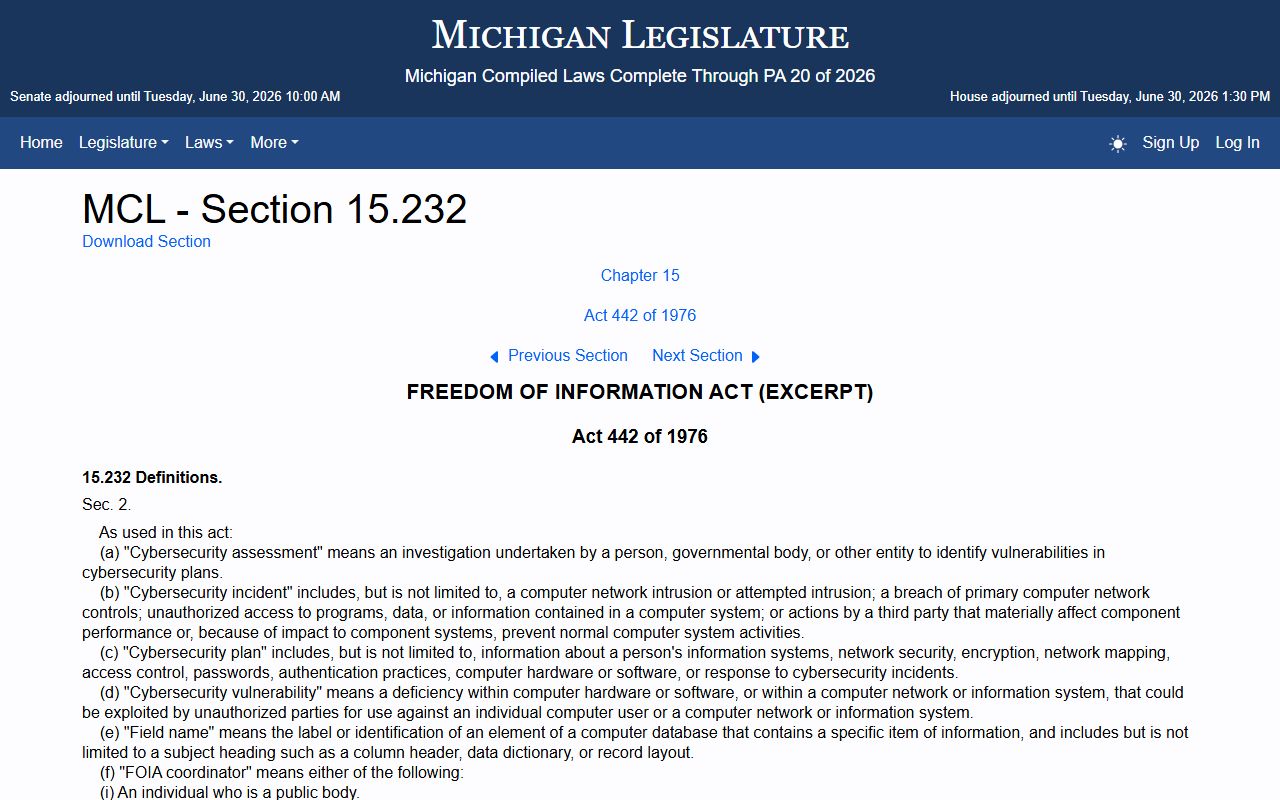
That exemption means the clerk of court, not the county FOIA officer, controls access to filed charges and case files.
For records the sheriff holds, the office answers requests through its own FOIA channel, separate from the court file.
When access is blocked, the reason is usually written into the record, whether as a sealing order, a juvenile designation, or a statutory exemption. Asking the wrong office wastes time. Charge and case questions go to the court clerk, while arrest and booking questions go to the sheriff, and each follows its own rules.