
Criminal Court Records in Cass County
A criminal court record is the case file the court opens once formal charges are filed against a defendant. In Cass County that file holds every step the court takes, from the first appearance to the final judgment. The County Clerk/Register of Deeds is the keeper of circuit court records, while the district court runs its own file room for the cases it handles. Each record carries a case number, the charges, the parties, and a running list of events. Some entries are short docket lines. Others are full orders signed by a judge. Together they form the official account of how the state handled the matter.
Adult criminal cases in Cass County move through two trial courts. The 4th District Court handles misdemeanors, which carry up to one year in jail, and it manages the front end of every felony. The 43rd Circuit Court is the felony court, where cases continue after a district judge sends them up. That split means a single case can leave a trail in two file rooms. Misdemeanor files usually stay in the district court. Felony files begin there and finish in circuit court. The charge level tells you which court holds the bulk of the record.
How to Search Cass County Criminal Records
Most Cass County criminal court records are searched online through MiCOURT Case Search, the statewide case lookup run by the Michigan courts. The portal covers criminal, civil, traffic, family, and probate matters, and it lets a user search by name or case number. Not every field is visible. State and federal law block certain details, so a public search returns the public layer of the file, not the sealed parts.
- Open the MiCOURT Case Search portal and choose the search type.
- Enter the defendant's name, or the case number if you have it.
- Narrow the results by court, case type, and filing date.
- Open the case to read the docket, charges, and disposition.
- Order a certified copy from the clerk's file room when you need one for official use.
For a broader view, the Michigan Courts also host a case search landing page with a public-access notice. Live hearing details sit on the county's circuit and probate docket, which refreshes every 30 minutes. A statewide criminal history goes beyond any single case and is handled by the Michigan State Police, not the county clerk.
When a record is not online, the file room is the fallback. The district court file room and the circuit court file room each keep the paper and imaged files for their own cases. Staff can pull an older case, confirm a disposition, or prepare a certified copy for a fee. Certified copies are the version courts and agencies accept, since an uncertified printout carries no official weight.
Stages of a Cass County Criminal Case
A criminal case follows a set path, and each stage adds to the record. It starts when the prosecutor files a complaint, and in many cases a judge issues a warrant. The defendant is arraigned, enters a plea, and the case either settles or goes to trial. Felonies pass through a preliminary exam in district court before bindover to the circuit court.
Case flow: Charges Filed › Arraignment › Pretrial / Motions › Plea or Trial › Disposition › Sentencing
| Stage | What Happens |
|---|---|
| Arraignment | The defendant hears the charges, is advised of their rights, and enters a first plea. The judge sets bond and release conditions. |
| Pretrial / Motions | Lawyers exchange evidence and file motions. Felonies get a preliminary exam here before moving up to circuit court. |
| Plea or Trial | Most cases end in a plea. If not, a judge or jury decides guilt at trial. |
| Sentencing | After a guilty plea or verdict, the judge imposes jail, probation, fines, or other terms. |
Note: A felony that begins in the 4th District Court continues in the 43rd Circuit Court after bindover, so its record can span two separate file rooms.
What a Cass County Criminal Record Shows
Michigan criminal files use standard data fields, and the county's live dockets show the most common ones. A record identifies the case, names the people involved, and lists every event on the docket. It also carries the charges, the plea, and the outcome. Redaction rules keep some personal details out of public view, including account numbers and the names of minors.
| Field | What It Shows |
|---|---|
| Case Number | The unique file ID. Criminal cases often carry a CR prefix. |
| Defendant | The person charged, listed opposite the prosecuting agency. |
| Charges | Each count, its statute, and its level, such as misdemeanor or felony. |
| Plea | How the defendant answered, such as guilty, not guilty, or no contest. |
| Disposition | How the case ended, such as convicted, dismissed, or acquitted. |
| Sentence | The penalty imposed, including jail, probation, fines, or costs. |
Bond and financial entries also appear in criminal files. A record may list the bond amount, the release conditions, and any fines, costs, or restitution ordered at the end. Case status tells you whether the matter is open, pending, closed, or disposed. On a live docket, the same case can show upcoming hearing dates, times, and the courtroom.
Charges vs. Convictions
Being charged is not the same as being convicted. A charge is an accusation that a crime occurred. A conviction is a finding of guilt, entered by plea or verdict. A criminal court record can show charges that were later dropped, dismissed, or that ended in acquittal, and those entries stay visible unless the file is set aside. Reading the disposition matters as much as reading the charge.
| Charge | Conviction | |
|---|---|---|
| Stage | Accusation | Verdict or plea |
| Burden of Proof | Probable cause | Beyond reasonable doubt |
| Public Record | Yes | Yes |
Reading Cass County Criminal Dispositions
The disposition is the bottom line of a criminal file. Common results include guilty, not guilty, dismissed, and no contest, which the record may label as nolo contendere. A no contest plea accepts the penalty without admitting guilt. Some cases end in a deferred or delayed outcome, where the court holds judgment while the defendant meets conditions. If the terms are met, the charge may be dismissed.
The sentence sits next to the disposition. A Michigan sentence can include jail, probation, fines, court costs, restitution, and treatment. Cass County runs problem-solving courts that shape some sentences, including Adult Treatment Court and Sobriety Court on the district side and Mental Health Court on the circuit side. The record notes the terms and tracks whether the defendant completed them.
A few terms show up again and again in these files.
- Arraignment
- The first court appearance, where charges are read and a plea is entered.
- Bindover
- The transfer of a felony from district court to circuit court after a preliminary exam.
- No contest
- A plea that accepts the penalty without admitting guilt.
- Deferred judgment
- A hold on the outcome while the defendant meets set conditions.
- Restitution
- Money a defendant must pay to cover a victim's loss.
Sealed vs. Expunged Records
Michigan draws a line between a record that is hidden and one that is set aside. A sealed file is closed to public view but still exists. An expunged, or set aside, conviction is treated as though it never happened for most purposes. The state's expungement law controls who qualifies and how the process works.
Michigan's main set-aside statute, MCL 780.621, lays out the eligibility rules and waiting periods for clearing a conviction.
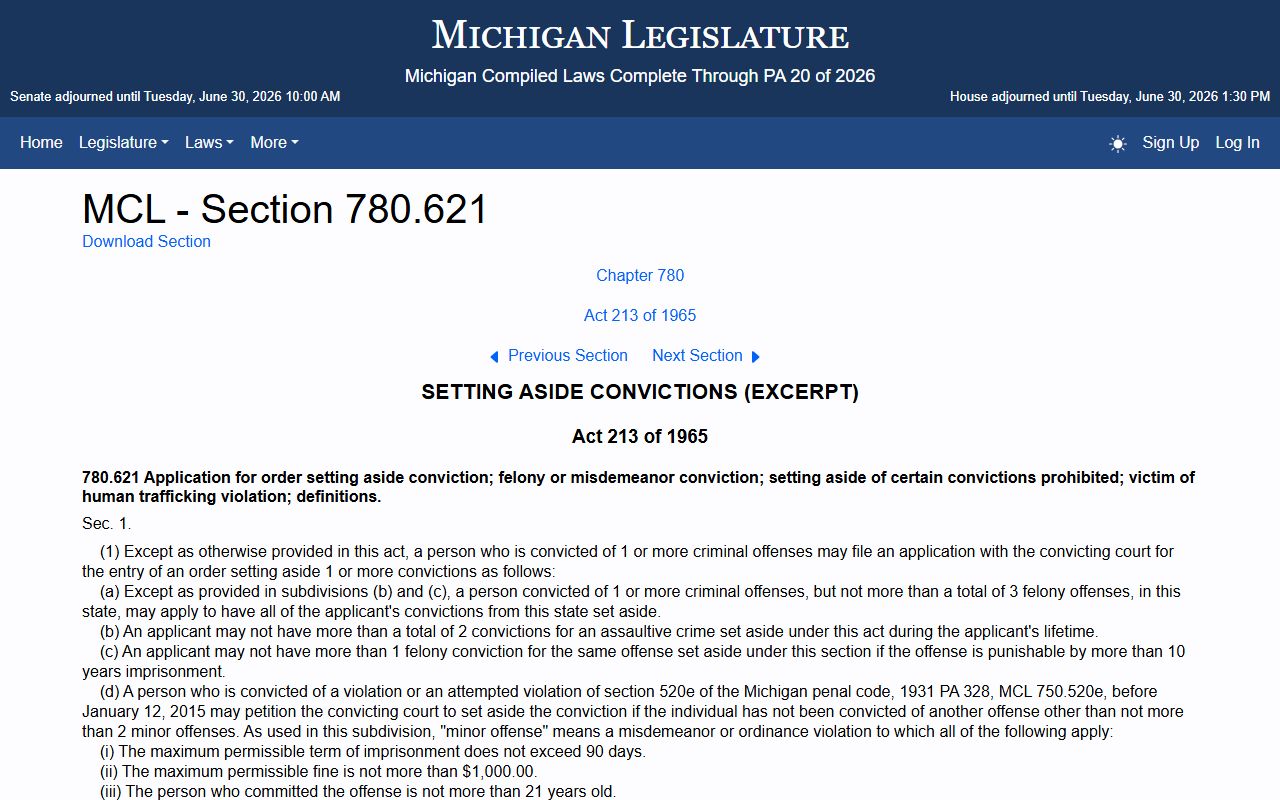
The statute and its related sections decide which Cass County criminal court records can be cleared and which stay on the public file.
| Sealed | Expunged | |
|---|---|---|
| Visibility | Hidden from public | Treated as never existed |
| Law Enforcement | Limited access | Very limited access |
| Eligibility | By court order under Michigan court rules | Under MCL 780.621, after waiting periods |
Michigan added automatic set-aside for some convictions under MCL 780.621g, which clears eligible records without a formal application. Juvenile records follow a separate rule. Under MCL 712A.28, they are kept by the court and opened only by court order. Not every case qualifies for either path, and serious offenses are excluded.
Note: A set-aside removes a conviction from public systems, but law enforcement and the courts keep a nonpublic copy for limited, legally defined uses.
Public Access to Cass County Criminal Records
Michigan treats court files as public by default, but the rules differ from ordinary county records. The judiciary is not a public body under the state FOIA, so court records are reached through the courts and their rules, not a standard FOIA request. The filing and redaction standards in MCR 1.109 keep protected data out of the public file.
Key Statutes:
Michigan Court Rule 8.119 - Defines court records and sets public access, sealing, and electronic access rules.
MCL 15.232 - Michigan FOIA definitions, which exclude the judiciary and explain why court files are not ordinary FOIA records.
In practice, most people never file anything to see a case. They open the case portal, read the docket, and stop there. The formal rules matter most when a file is sealed, when a record looks incomplete, or when a certified copy is needed for another court.
Background Check Considerations
A casual name search is not the same as a background check. Employers, landlords, and licensing bodies that make decisions under the federal Fair Credit Reporting Act must use a compliant screening process. A raw court lookup can miss context, mix up common names, or show charges that never led to a conviction. For any regulated decision, the certified court file and a proper screening service are the reliable sources.
Important: This site is not a consumer reporting agency under the Fair Credit Reporting Act, and its information cannot be used for employment, housing, credit, or other FCRA-regulated screening.
Restricted Criminal Court Records in Cass County
Not every criminal matter is open to the public. Juvenile cases are restricted by statute and court rule, and a confidential social file sits behind them. Sealed and expunged cases drop out of public view once a judge signs the order. Ongoing investigations, warrant materials before service, and records held under a protective order can also be withheld. Mental health and adoption matters carry their own confidentiality, even when a docket exists. When a file is closed, the county's clerks cannot release it without legal authority.
For a closer look at the accusations themselves, the arrest-to-charge pathway is covered on the Cass County arrest records and charges page, and every court file type sits under the county's court records overview.